



July 31, 2026 | Posted By: Emma Doull
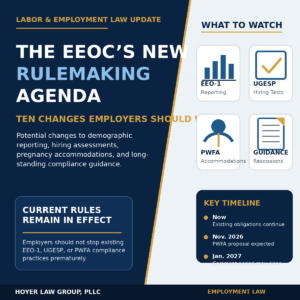 Just before the Independence Day holiday, the Equal Employment Opportunity Commission quietly published an updated Unified Agenda of Federal Regulatory and Deregulatory Actions listing ten rulemaking initiatives that could reshape how employers handle demographic data, hiring assessments, pregnancy accommodations, and long-standing compliance guidance. None of these items has become a final rule yet, and current requirements remain fully in effect. But the agenda gives employers a clear preview of where the Commission is headed, and several of the changes could move quickly. This builds on the enforcement priorities the EEOC laid out earlier this year in its National Enforcement Plan, and employers who read that plan closely will recognize the same underlying themes here.
A Possible End to EEO-1 and Related Reporting
The most consequential item on the agenda is the EEOC’s plan to rescind, or formally withdraw, the regulations requiring EEO-1, EEO-2, EEO-3, EEO-4, and EEO-5 reports, the demographic data filings that private employers, unions, state and local governments, school systems, and apprenticeship programs have submitted for decades. The Commission describes these as agency-created requirements that impose a significant financial and administrative burden, and it cites millions of annual reporting hours across the workforce as justification. The agency has also tied part of the reasoning to the rescission of Executive Order 11246, which previously extended similar reporting obligations to federal contractors.
If finalized, this would eliminate the federal government’s single largest source of employer workforce demographic data. For now, though, this remains only an agenda entry, and employers should continue their existing data collection and reporting practices until a final rule says otherwise.
Uniform Guidelines on Employee Selection Procedures Under Review
The agenda also includes two related initiatives targeting the Uniform Guidelines on Employee Selection Procedures, commonly known as UGESP, which has served since 1978 as the EEOC’s framework for evaluating whether hiring tests, promotional assessments, and other selection procedures create an unlawful adverse impact. One proposal would rescind the interpretive portions of UGESP and its appendix, citing the guidelines’ age relative to the Civil Rights Act of 1991. A second, separately docketed proposal would eliminate the recordkeeping provisions tied to UGESP, which currently require employers to retain data sufficient to evaluate adverse impact and to document any validation studies performed on their selection procedures.
Together with the EEO-1 rescission, these UGESP changes would remove much of the federal recordkeeping and reporting infrastructure that has historically supported disparate impact analysis. That aligns with the Commission’s stated intent, as expressed in its National Enforcement Plan, to prioritize disparate treatment theories over disparate impact theories going forward. Disparate impact liability itself remains written into Title VII and cannot be erased by agency rulemaking alone, but the tools employers and regulators have relied on to measure it could look very different if these proposals are adopted.
Pregnant Workers Fairness Act Regulations May Be Narrowed
The EEOC has also signaled plans to revise its regulations implementing the Pregnant Workers Fairness Act, specifically the definition of conditions related to pregnancy and childbirth that trigger an employer’s duty to accommodate. The agency has not released proposed text, so the scope of the change is not yet clear. Context is still useful here. Current EEOC Chair Andrea Lucas voted against the original PWFA regulations, writing at the time that they improperly extended accommodation obligations to reach nearly any condition connected to female reproductive health rather than limiting the rule to pregnancy and childbirth itself. If the revised regulations reflect that earlier position, employers could see a narrower accommodation obligation than the one currently in place. This proposal is designated economically significant, a label reserved for rules with a major economic impact, with a Notice of Proposed Rulemaking anticipated in November 2026 and a comment period expected to close in January 2027, so employers have time to plan and, if they wish, participate in the comment process once the text is released.
A related item would rescind the appendix to the EEOC’s Guidelines on Discrimination Because of Sex, which predates the PWFA and, according to the agency, no longer reflects the current statutory framework governing pregnancy-related rights in the workplace. Employers who handle pregnancy discrimination accommodation requests should watch both items closely, since they move on a faster timeline than the broader PWFA regulatory revision.
Decades-Old Interpretive Guidance on the Chopping Block
Several agenda items target interpretive guidance dating back to the late 1970s and early 1980s. The EEOC intends to rescind its 1980 Guidelines on Discrimination Because of National Origin, which the agency says incorrectly presumes that English-only workplace rules violate Title VII, a position it views as inconsistent with the burden-of-proof standards Congress established in the Civil Rights Act of 1991. The guidelines also rely almost entirely on Commission decisions from 1969 to 1975 and cite no judicial authority issued after 1980, which the agency cites as further reason for rescission.
The Commission has already taken action on a related item. On June 29, 2026, the EEOC voted to rescind its 1979 interpretive rule on affirmative action under Title VII, stating that the move reaffirms that Title VII’s protections apply equally to all workers. Because relatively few employers relied on the narrow affirmative action provisions that guidance permitted, this particular rescission is unlikely to require significant changes to current practice, but it fits the same pattern of the Commission clearing older interpretive materials it views as outdated.
Administrative Changes Round Out the Agenda
The remaining items are largely procedural. The EEOC plans to eliminate the requirement that field offices maintain public reading rooms and to revise how it processes requests for charge file copies. It also intends to move its list of designated and certified Fair Employment Practices Agencies from its regulations to its website, and to adjust the civil monetary penalty for federal notice-posting violations to comply with mandatory inflation adjustments. None of these items requires employer action, but they round out a picture of an agency actively reworking its regulatory footprint on multiple fronts at once.
What Employers Should Do Now
Because these items remain agenda entries rather than issued rules, current EEO-1 reporting, UGESP recordkeeping, and PWFA accommodation obligations all remain fully in force. The practical risk for employers is acting too early, whether by prematurely stopping demographic data collection that may still be required at the state level, or by assuming a broader PWFA accommodation duty has already narrowed when it has not. Employers should also remember that several states, including some with their own pay data or EEO reporting statutes, are unlikely to eliminate their own requirements even if the federal EEO-1 obligation disappears. Businesses that want help sorting out which obligations are changing and which remain firmly in place may benefit from working with HR consulting services or an employment law attorney who can track each proposal as it moves through the rulemaking process.
If your business wants help understanding how these EEOC rulemaking initiatives could affect your reporting, hiring, and accommodation practices, contact Hoyer Law Group for a confidential evaluation. Visit our contact page or call (844) 531-0082 to speak with our team.
This blog is for general informational purposes only and does not constitute legal advice. For advice specific to your situation, please consult a qualified attorney.