

June 21, 2026 | Posted By: Emma Doull
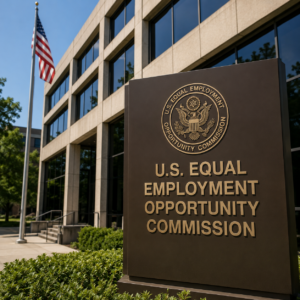 If your company is subject to federal employment law, and nearly every employer with 15 or more employees is, a significant shift in government enforcement priorities just took effect. On June 4, 2026, the U.S. Equal Employment Opportunity Commission (EEOC) released its National Enforcement Plan (NEP) for Fiscal Years 2025-2029, replacing the agency’s prior 2024-2028 Strategic Enforcement Plan. The new NEP signals a significant shift in how the EEOC intends to deploy its investigative and litigation resources over the next several years.
For employers, this is not background news. The NEP shapes which workplace complaints the EEOC pursues aggressively and which types of claims it prioritizes in federal court. Understanding these shifts now gives businesses an opportunity to review their own practices before any complaint ever arrives.
What Is the EEOC’s National Enforcement Plan?
The EEOC is the federal agency responsible for enforcing workplace anti-discrimination laws, including Title VII of the Civil Rights Act, the Age Discrimination in Employment Act (ADEA), the Americans with Disabilities Act (ADA), and the Equal Pay Act. The NEP is an internal policy document that guides the agency in allocating its limited enforcement resources, including which investigations to prioritize, which cases to bring to court, and which legal theories to advance.
The 2025-2029 NEP represents a notable departure from recent EEOC enforcement philosophy and aligns with executive orders issued by the Trump administration. Chair Andrea R. Lucas has publicly stated her intention to reorient the agency’s mission, and the new NEP formalizes that direction.
From Disparate Impact to Disparate Treatment
One of the most significant changes in the NEP is its shift away from “disparate impact” claims toward “disparate treatment” claims. Understanding the difference matters for employers.
Disparate treatment claims involve intentional discrimination, for example, refusing to promote an employee because of their race or terminating someone because of their religion. Disparate impact claims, by contrast, arise when a neutral workplace policy unintentionally produces a statistically disproportionate effect on a protected group, even if no one intended to discriminate.
The new NEP directs the EEOC to prioritize disparate treatment claims and to minimize the use of disparate impact theories “to the maximum degree possible.” The agency characterized intentional discrimination as “inherently more egregious” than unintentional disparities. Reinforcing this direction, on June 9, 2026, the U.S. Department of Justice’s Office of Legal Counsel issued a nonbinding opinion concluding that the EEOC’s own disparate impact guidelines under Title VII may be unconstitutional.
This does not eliminate disparate impact liability entirely, and employers should not treat this shift as a green light for facially neutral policies that produce discriminatory outcomes. State law and independent federal court interpretations remain in force. But it does signal where the EEOC’s prosecutorial attention will be directed.
DEI Programs Are Now a Priority Target
The NEP specifically identifies diversity, equity, and inclusion (DEI) programs, described as “similar euphemisms,” as a priority enforcement area. The agency will scrutinize employer DEI initiatives that it concludes result in “facially discriminatory practices” or intentional discrimination based on race, sex, or other protected characteristics.
This puts employers in a genuinely complex position. On one hand, many states have laws that may require or encourage certain diversity-related practices. On the other hand, the EEOC is now signaling that it will treat some DEI-related employment decisions, such as race-conscious hiring or promotion criteria, as potential violations of Title VII.
Employers with active DEI programs should review them carefully with employment counsel to assess compliance risks under both federal and applicable state law. The goal is not necessarily to dismantle DEI efforts, but to ensure that hiring, promotion, and evaluation decisions are based on neutral, job-related criteria that can withstand federal scrutiny.
Other Enforcement Priorities Under the NEP
Beyond the DEI focus, the NEP identifies several other areas where the EEOC intends to concentrate resources:
- Recent Supreme Court decisions. The agency will prioritize cases implicating recent rulings, including the Court’s 2023 decision in Groff v. DeJoy, which raised the bar for employers seeking to deny religious accommodations to employees under Title VII. Employers must demonstrate “undue hardship” with concrete evidence, not generalized assumptions.
- Pregnant Workers Fairness Act. The EEOC will focus on employer obligations under the PWFA, which requires reasonable accommodations for pregnancy, childbirth, and related conditions. Employers who have not yet updated their accommodation policies to reflect the PWFA should do so promptly.
- Protection of vulnerable workers. The NEP calls for targeted enforcement on behalf of teenage workers, individuals with limited literacy or formal education, low-wage earners, survivors of sexual assault, and workers with developmental or intellectual disabilities. Employers in industries that rely heavily on these workers, including hospitality, agriculture, and warehousing, should pay close attention.
- Single-sex spaces and binary sex. Chair Lucas has made clear that the EEOC under her leadership will prioritize employer rights to maintain single-sex workplace spaces and will push back on gender identity claims that it views as inconsistent with a binary definition of sex. This is an area of active legal conflict, with federal circuit courts reaching different conclusions, and employers should monitor developments closely.
- Federal circuit splits. The NEP calls on the EEOC to pursue appellate cases that clarify the scope of employer liability and resolve disagreements among the federal circuits. This suggests the agency may pursue cases specifically to shape national legal standards, which can affect employers well beyond the circuits where those cases arise.
What Employers Should Do Now
The NEP does not change the text of federal anti-discrimination statutes. Employers remain legally obligated to comply with Title VII, the ADA, the ADEA, the PWFA, and all other applicable employment laws. What changes is where enforcement attention will fall.
A few practical steps are worth considering in light of the new plan.
- First, audit your hiring and promotion processes. If your company uses scoring systems, interview protocols, or selection criteria with disparate impact on protected groups, those practices warrant legal review even if the EEOC is now de-emphasizing disparate impact claims, because private plaintiffs and state agencies may still pursue them.
- Second, review your DEI programs with employment counsel. Ensure that any diversity initiatives are structured to support, rather than condition, employment decisions based on protected characteristics.
- Third, revisit your religious accommodation process. After Groff v. DeJoy, a blanket denial based on administrative inconvenience is no longer sufficient. Employers must engage in an individualized inquiry and document their analysis.
- Fourth, review pregnancy and disability accommodation policies for PWFA compliance, which has been in effect since June 2023 and continues to be an active area of EEOC enforcement regardless of broader policy shifts.
If you are an employer with questions about how the EEOC’s new enforcement priorities may affect your workplace practices, or if you are an employee who believes you have experienced workplace discrimination, Hoyer Law Group can help. Our employment law attorneys advise clients nationwide on discrimination, retaliation, and wrongful termination matters.
Contact Hoyer Law Group
If you have questions about the EEOC’s new enforcement priorities and what they mean for your business or your rights as an employee, we encourage you to reach out for a confidential evaluation. Contact Hoyer Law Group at hoyerlawgroup.com/contact/ or call us at (844) 531-0082.
This blog is for general informational purposes only and does not constitute legal advice. For advice specific to your situation, please consult a qualified attorney.