

December 26, 2025 | Posted By: Emma Doull
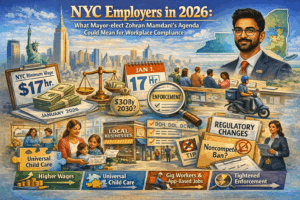 New York City employers are heading into 2026 with a meaningful shift on the horizon. Mayor-elect Zohran Mamdani is scheduled to take office on January 1, 2026, and early reporting on his transition and public agenda points toward a more worker-first regulatory environment. Even where the city cannot implement a proposal on its own, the policy direction still matters. It can shape enforcement priorities, influence agency resources, and increase the likelihood that Albany faces pressure to act.
Employers should treat 2026 as a year where compliance risk may rise, not necessarily because every proposal becomes law immediately, but because the overall enforcement environment could become more active and less forgiving.
Minimum Wage
Wages will likely sit at the center of the 2026 conversation. Mamdani has supported a long-range goal of raising the minimum wage to $30 per hour by 2030, and major outlets have described that as one of his signature proposals. Employers should separate the politics from the immediate compliance reality. New York State already has scheduled minimum wage increases for New York City. The New York State Department of Labor explains that minimum wage rates vary by region and confirms a planned $0.50 increase on January 1, 2026. Secondary summaries for employers state that the 2026 New York City rate is $17.00 per hour and point to the state’s multi-year schedule.
In other words, wage pressure is not theoretical. Employers should assume upward movement will continue, both through statutory increases and market forces. Even if the “$30 by 2030” concept never becomes law, employers should expect continued upward pressure on wages.
Child Care Policy
Child care policy is another area to watch, because it can affect workforce stability even before a final program is fully built out. Mamdani has highlighted universal child care as a major affordability initiative, and polling has shown broad support for universal free child care funded by higher taxes on high earners. The employer angle is practical. Child care instability drives absences, turnover, and reduced availability. Reporting in New York City has cited significant economic impacts tied to parents leaving the workforce or cutting back hours because they cannot access affordable care, including estimates that the city lost about $23 billion in economic activity in 2022 from child care constraints.
Employers do not need to wait for a citywide program to start reducing that friction. Businesses can stress-test scheduling assumptions, adopt more predictable scheduling practices where feasible, consider dependent-care benefits, and build relationships with local providers so they can move quickly if public-private partnership opportunities appear.
App Based Workers
Employers should also watch continued regulation of app-based and gig-economy work, particularly delivery. New York City has already taken major steps here through Department of Consumer and Worker Protection rulemaking and minimum pay requirements for app-based delivery workers, and DCWP maintains public guidance on the minimum pay rate framework. Even if the legal obligations fall primarily on platforms, the impact extends to restaurants, grocers, retailers, and businesses that rely on delivery ecosystems. Higher delivery costs, revised contract terms, service-area changes, and operational disruptions can all flow downstream. Public sources frequently describe the delivery workforce as numbering in the tens of thousands, with some reporting referencing an industry of roughly 80,000 workers.
If the incoming administration pushes for stronger protections, additional licensure requirements, or new infrastructure initiatives, employers that rely heavily on delivery should anticipate vendor renegotiations and customer-facing pricing changes.
Noncompete Agreements
Restrictions on noncompete agreements may also return to the local legislative agenda. The New York City Council’s legislative system includes a proposal that would prohibit noncompete agreements and authorize enforcement and civil penalties. Legal analyses describe the bill as broad, and potentially disruptive for employers that use noncompetes as a default tool for retention or protection of client relationships.
The practical takeaway is not that every restrictive covenant becomes unlawful overnight. That said, businesses that rely on noncompetes should take the time now to identify which roles truly require heightened protection and then shift emphasis toward tools that are often more durable, such as strong confidentiality provisions, access controls, trade secret protocols, and carefully drafted non-solicitation provisions to the extent permitted.
Tax Issues
Tax proposals will likely generate headlines, but employers should focus on the parts that change day-to-day compliance risk. Public reporting and analysis of Mamdani’s agenda have described proposals to raise the state’s top corporate tax rate to 11.5% and to add a city income tax surcharge or new bracket affecting residents with income over $1 million, although accounts vary in how they characterize the specific rate and mechanism. Those changes would require state-level action, and the political path is uncertain.
Increased Enforcement?
What the city can influence more directly is enforcement intensity and agency capacity. Employer-facing commentary has highlighted the possibility of increased attention to wage theft, misclassification, and scheduling compliance through expanded worker-protection enforcement. Employers should also keep in mind that New York City already enforces one of the nation’s broadest anti-discrimination regimes through the NYC Human Rights Law, and the NYC Commission on Human Rights plays a central role in enforcement and education. If the administration invests in staffing or faster enforcement pipelines, employers could see more investigations, tighter timelines, and higher expectations for training, documentation, and consistent complaint handling.
At the same time, employers should not assume the shift is only punitive. Small businesses may see service improvements alongside stricter enforcement. Employer-focused analysis of Mamdani’s proposals describes plans to streamline permitting and expand small business support through expanded Business Express Service Teams (BEST) and improvements to the MyCity Business Portal. If those efforts reduce delays that stall openings, renovations, and expansions, businesses that engage early may benefit from faster answers and cleaner records, which can matter if enforcement increases elsewhere.
All of these changes will unfold within political and fiscal constraints. Employers should plan for change in phases rather than assuming every proposal becomes law immediately. A realistic approach is to prepare for a worker-first direction while building flexible compliance systems that can adapt as final rules, budgets, and enforcement priorities take shape.
Takeaways
In practical terms, employers can reduce risk in 2026 by taking several steps now, even before any new local laws pass.
- First, model wage costs beyond the statutory minimum and create a plan to address wage compression, which can drive turnover among leads and supervisors.
- Second, review restrictive covenant templates and move toward role-specific, narrowly tailored protections rather than one-size-fits-all noncompetes.
- Third, run an internal wage-and-hour checkup focused on timekeeping accuracy, meal and break compliance where applicable, tip and service-charge practices, exempt classifications, and contractor relationships, because those are common flashpoints for agency enforcement and private litigation.
- Fourth, refresh anti-discrimination and harassment training and confirm that complaint procedures work in practice, not just on paper, since faster enforcement environments reward employers who document prompt, consistent responses.
- Finally, assign an internal owner to track DCWP and other agency updates so the business can respond quickly as guidance and enforcement initiatives evolve.
If your New York City business has questions about wage compliance, scheduling practices, independent contractor risk, noncompete strategy, or discrimination prevention, the attorneys at Hoyer Law Group are here to help. We advise employers on policy updates, workforce documentation, and risk-reduction strategies that align with shifting enforcement priorities. Our team can review agreements, audit compliance programs, and support HR and leadership as the city’s workplace landscape evolves.
Contact Hoyer Law Group today to schedule a confidential consultation and learn how we can support your compliance and talent strategy.