

January 09, 2026 | Posted By: Emma Doull
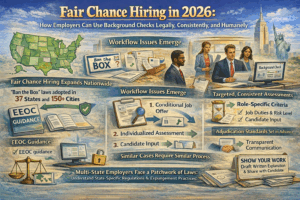 The offer is out, the start date is penciled in, and then a background check report lands with something that makes everyone pause. A hiring manager contacts HR. HR contacts Legal. Someone asks, “What do we do now?” In that moment, fair chance hiring stops being a slogan and becomes a real workflow issue, with legal exposure, reputational risk, and a human being on the other side of the process.
That is exactly why so many jurisdictions have moved beyond simple “Ban the Box” rules and into more detailed requirements for how employers must handle criminal history. In 2026, employers should assume this trend continues. If your hiring practices have not kept up, the risk is not just technical noncompliance. The bigger risk is inconsistent decision-making, poor documentation, and avoidable claims that a denial was unfair or discriminatory.
What Fair Chance Hiring Really Means Now
Ban the Box laws were the first major shift. They generally limit criminal history questions at the beginning of the hiring process, forcing employers to assess qualifications before considering criminal records.
Modern fair chance laws go further. They increasingly require employers to “show their work” when criminal history influences a hiring decision. That often includes:
- Waiting until after a conditional offer before reviewing criminal history.
- Conducting an individualized assessment rather than relying on blanket exclusions.
- Providing written notices and supporting documents.
- Giving the candidate a meaningful opportunity to respond before a final decision is made.
New York City’s Fair Chance Act is one of the clearest examples of this approach. It generally requires employers to wait until after a conditional offer, perform an individualized assessment using the required factors, provide the candidate with the assessment and the criminal history information relied upon, and allow time, often five business days, for the candidate to respond.
Why This Matters More in 2026
Fair chance hiring matters in 2026 because the legal trend line is not slowing down. A widely cited national survey reports that 37 states and more than 150 cities and counties have adopted Ban the Box measures, and more jurisdictions continue to add rules and enforcement mechanisms.
Even where a particular state does not impose a private-employer Ban the Box law, employers still face federal guardrails. Under longstanding Equal Employment Opportunity Commission guidance, blanket criminal record exclusions can create discrimination risk if they disproportionately impact protected groups. The EEOC has emphasized that criminal history policies should be job-related and consistent with business necessity, and it highlights targeted screening based on the “Green factors”:
- The nature of the offense
- The time elapsed
- The nature of the job
The takeaway for employers is simple. You cannot treat criminal history as a universal disqualifier. You need a job-connected reason, and you need a process that allows for individualized review.
The Business Case: Fair Chance Hiring Is Also a Risk Management Tool
Employers feel the impact of fair chance hiring in very practical ways.
First, it can expand the talent pool, especially in industries with tight labor markets and high turnover.
Second, it can strengthen an employer’s brand. Candidates increasingly evaluate companies based on fairness and transparency in the hiring process.
Third, and most important from a legal perspective, fair chance hiring forces consistency. A repeatable decision process is easier to defend than ad hoc, manager-driven judgment calls made under time pressure. That is the operational heart of fair chance hiring. It pushes employers to make decisions the same way every time, and to document those decisions while the process is still active.
The Patchwork Problem: Multi-State Employers Need a Flexible Workflow
One of the hardest parts of fair chance compliance is that it is not uniform. Multi-state employers know this well.
California’s Fair Chance Act, for example, generally restricts employers with five or more employees from inquiring into criminal history until after a conditional offer, subject to exceptions.
Illinois takes a different approach through the Job Opportunities for Qualified Applicants Act, which generally prohibits inquiry into or consideration of criminal history until the applicant is determined qualified and selected for an interview, or if there is no interview, until after a conditional offer.
New York City layers on additional obligations, including an individualized assessment and a written notice process before taking adverse action.
This is why fair chance compliance is not just a handbook policy. It is a workflow design issue. Your hiring process must flex across jurisdictions without breaking.
Background Check Data Is Not Perfect, and Employers Need to Plan Accordingly
Employers sometimes build hiring systems based on assumptions that do not hold up in the real world. Records availability varies by state and county. Data quality varies by source. Expungement and sealing laws can change what appears, or does not appear, over time.
Michigan’s Clean Slate program is a good example. Michigan began rolling out automatic expungements starting April 11, 2023. Some convictions that might have appeared historically may no longer show up in a routine search once they qualify for automatic set-aside.
The lesson is not that employers should screen less carefully. It is that employers should screen more realistically. Your process should account for the limits of available data instead of pretending those limits do not exist.
Timing Matters: How Fair Chance Laws Interact with the FCRA
Many HR teams already understand the Fair Credit Reporting Act adverse action sequence when they use a consumer reporting agency for background checks. If a consumer report contributes to a negative decision, the employer typically provides:
- A pre-adverse action notice with a copy of the report and a summary of rights
- A waiting period that is long enough for the candidate to respond
- A final adverse action notice if the employer proceeds with the decision
Fair chance laws often require more than that. They typically require the individualized assessment and the candidate’s opportunity to respond to happen while the decision is still open, not after the employer has effectively made up its mind. If your current workflow treats notice as a cleanup step after an internal “no” decision, you may be out of step with jurisdictions like New York City.
What a Good Individualized Assessment Looks Like
An individualized assessment does not need to read like a legal brief. It should read like a clear business judgment tied to job duties, and it should be documented consistently.
A strong assessment usually answers these questions:
- What are the actual duties of this job, and what risks are relevant to those duties?
- What does the record show, limited to legally permissible and relevant information?
- Why does this particular record matter for this particular role?
- How long ago did it occur, and what has changed since then?
- What did the candidate say in response, and how did that affect the analysis?
This approach aligns with the EEOC’s emphasis on evaluating criminal history through the nature of the offense, the time elapsed, and the nature of the job, rather than using blanket exclusions.
Building a Defensible Process: Practical Steps Employers Can Take Now
Even if your jurisdiction does not require every step yet, adopting best practices now usually makes multi-state compliance easier and reduces the risk of inconsistent decision-making.
Employers should consider the following steps:
- Build role-based screening packages that you can explain in plain English. One-size-fits-all background checks lead to inconsistent decisions and frustration for both managers and candidates.
- Decide adjudication standards before you are under pressure. When a surprising report appears unexpectedly, stakeholders improvise, timelines stretch, and candidates experience the process as arbitrary. A role-based matrix aligned with job duties and EEOC principles makes decisions faster, more consistent, and easier to defend.
- Train hiring managers on what not to ask. Ban the Box violations often happen casually in interviews when someone wants “context.” Managers need clear boundaries about when criminal history can be discussed and how those discussions should be handled.
- Treat documentation as part of the workflow, not an afterthought. Fair chance compliance often turns on what you can prove later, not what you remember.
- Work with reputable screening partners. Employers and consumer reporting agencies both benefit from keeping current on compliance guidance, evolving data practices, and jurisdiction-specific requirements.
The Bottom Line for 2026
Fair chance hiring is not about perfection. It is about having a process you can stand behind.
Employers in the strongest position are not trying to eliminate all risk. They are building hiring systems that match screening scope to the role, document decisions consistently, give candidates a real opportunity to respond, and acknowledge that background data varies across jurisdictions and over time.
When employers do that, fair chance hiring stops being abstract. It becomes a hiring practice that is lawful, practical, and defensible.
If your organization has questions about fair chance hiring, Ban the Box compliance, background check workflows, or individualized assessments, our attorneys at Hoyer Law Group are here to help. We advise employers on multi-state hiring compliance, policy drafting, manager training, and risk-reduction strategies that align with EEOC guidance and evolving state and local requirements. Contact Hoyer Law Group today to schedule a confidential consultation and learn how we can support your hiring and compliance strategy.