

January 25, 2026 | Posted By: Sean Estes
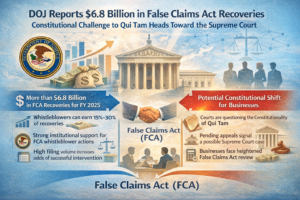 A routine compliance lapse can turn into an existential problem when federal dollars are in the revenue stream. That is the central message of the U.S. Department of Justice’s latest False Claims Act (“FCA”) annual results: DOJ reported more than $6.8 billion in FCA settlements and judgments for the fiscal year ending September 30, 2025, the highest single-year total DOJ has reported under the statute.
Just as significant, DOJ reported 1,297 new qui tam suits filed in FY 2025, breaking the prior record set in FY 2024. DOJ also reported that recoveries in qui tam matters (including cases filed in earlier years but resolved in FY 2025) exceeded $5.3 billion.
These datapoints cut both ways. For relators, the data confirms that FCA whistleblower enforcement remains one of the federal government’s most active and financially meaningful tools. For businesses, they are a reminder that FCA exposure remains a board-level risk for any organization that bills federal programs, participates in federal procurement, receives federal grants, or operates in heavily regulated industries.
At the same time, a growing constitutional challenge to the FCA’s qui tam mechanism is building in the appellate courts and is increasingly being flagged by Supreme Court justices, raising the possibility of Supreme Court review in the right case.
What DOJ’s FY 2025 Numbers Signal for the FCA Landscape
The headline total matters, but the underlying signal matters more: FCA enforcement is not slowing down, and whistleblowers are driving a large share of the pipeline. DOJ’s press release emphasizes the central role of relators and reiterates that the relator’s share range (typically 15%–30%) when a qui tam case succeeds.
For relators, record filings and recoveries reinforce several practical realities:
- The government continues to treat FCA as a primary enforcement tool, particularly where federal program integrity is at stake.
- Even when DOJ declines to intervene initially, cases can still resolve favorably later, and DOJ’s totals include “earlier-filed” qui tam matters resolved during the fiscal year.
- The volume of filings increases the importance of early, well-supported case development—because not every complaint will receive the same level of attention in a crowded docket.
For businesses, the same numbers highlight why FCA risk is often less about a single “bad claim” and more about repeatable process failures: documentation shortcuts, sales or productivity pressures that outpace compliance guardrails, weak oversight of vendors and subcontractors, or drift from written program requirements. In an environment with record filings, those patterns are more likely to escalate into litigation.
Why This Is (Mostly) a Good Sign for Relators
Record recoveries do not mean every whistleblower case will succeed. But they do tend to correlate with three relator-friendly conditions:
Enforcement momentum increases the odds of meaningful government engagement
DOJ’s own reporting underscores the continued importance of qui tam cases to federal recoveries. In practice, that matters because intervention, resource allocation, and settlement leverage are heavily influenced by whether the government deems a category of misconduct an enforcement priority.
The Supreme Court has continued to recognize the FCA’s broad functional role
In Wisconsin Bell, the Supreme Court unanimously addressed a statutory question about what qualifies as a “claim” under the FCA in the context of E-Rate reimbursements. While that case did not decide the constitutionality of qui tam, the Court’s treatment of the statute—and the concurrences that separately discussed Article II questions – shows the FCA remains central, not peripheral, in the Court’s docket.
The continuing constitutional debate may change defense strategy more than relator strategy (for now)
Defendants are increasingly pressing Article II challenges. But today, qui tam remains viable nationwide. The near-term practical consequence is often motion practice and delay, rather than dismissal on constitutional grounds. That means strong relator cases still need to be built and prosecuted as if the current framework will remain in place through resolution.
The Article II Challenge to Qui Tam Is No Longer Just Academic
Defendants argue that the FCA’s qui tam structure improperly delegates executive enforcement power to private relators, raising Article II concerns (often framed through the Appointments Clause and/or Take Care Clause). The Supreme Court has not held the qui tam mechanism unconstitutional. But multiple justices have openly highlighted constitutional concerns in recent FCA decisions.
Polansky put the constitutional issue on the Supreme Court’s radar
In United States ex rel. Polansky v. Executive Health Resources, the Court decided a statutory issue about DOJ’s dismissal authority after intervening, but separate opinions flagged constitutional concerns as an issue the Court could address in an appropriate future case.
Wisconsin Bell revived the discussion
In Wisconsin Bell, concurring opinions again raised the Article II issue, reinforcing that the constitutional challenge remains “live” in the minds of at least some justices.
Appeals are developing the “right vehicle”
Two matters frequently cited as building the appellate record are:
- United States ex rel. Zafirov v. Florida Medical Associates (appeal in the Eleventh Circuit), where oral argument has been closely watched as part of the broader constitutional trend.
- United States ex rel. Murphy v. TriHealth, where the Southern District of Ohio certified an interlocutory appeal on the constitutionality question after addressing Article II arguments—illustrating that courts are treating the issue as substantial enough to warrant higher-court consideration.
What This Means for Businesses Facing FCA or Qui Tam Risk
For organizations on the defense side, the “record numbers + constitutional uncertainty” combination does not justify complacency. It increases the value of disciplined, provable compliance and fast internal response.
Do not treat constitutional litigation as a substitute for compliance
Even if the Supreme Court eventually narrows qui tam, DOJ can still bring FCA cases directly, and FCA exposure can still be triggered by the same underlying conduct. The practical and reputational costs of an FCA investigation typically arrive well before the constitutional issue is resolved.
Stress-test the places FCA problems actually start
Businesses should focus on operational points where FCA risk tends to originate:
- revenue cycle/claims generation and documentation
- certifications and attestations tied to payment eligibility
- subcontractor and vendor oversight
- sales incentive structures and productivity expectations
- grant compliance and reporting integrity
Strengthen internal reporting pathways to keep issues internal
A large share of FCA matters begin as internal concerns. Reporting channels reduce risk only if employees believe concerns will be taken seriously, investigated promptly, and handled without retaliation. When internal pathways are weak or distrusted, qui tam becomes the external alternative—particularly given the incentives DOJ highlights.
Practical Guidance for Relators Considering a Qui Tam Filing
Because your firm’s clients are primarily relators, it helps to be direct about what the current environment rewards:
Case strength still turns on evidence quality and narrative clarity
High filing volume means weak cases are easier to ignore. The relators who tend to do best are those who can translate “what I saw” into a coherent, document-supported explanation of (1) the false claim or false certification theory, (2) materiality, and (3) damages exposure.
Timing and preservation matter
Relators should assume that credibility and defensibility will be tested early, especially in sectors where defendants routinely litigate. Early case development, clean documentation paths, and careful handling of privileged or restricted materials can become outcome-determinative.
Expect more aggressive motion practice
As Article II arguments proliferate, relators should plan for more threshold litigation, not less. That does not change the fundamentals of building a strong FCA case; it changes the importance of having counsel who can litigate both the merits and the evolving constitutional overlay.
Closing Takeaway
DOJ’s FY 2025 results underscore a straightforward reality: FCA enforcement remains robust, and whistleblowers are driving much of the enforcement pipeline. Meanwhile, constitutional challenges to qui tam are advancing through appellate courts and drawing attention from Supreme Court justices – creating uncertainty about the long-term contours of qui tam, but not changing the near-term fact that FCA cases are being filed, litigated, and resolved at record levels.
If you want to discuss a potential qui tam matter or you are a business evaluating FCA exposure or responding to a whistleblower complaint or government inquiry, contact Hoyer Law Group, PLLC for a confidential case evaluation.