

January 17, 2026 | Posted By: Emma Doull
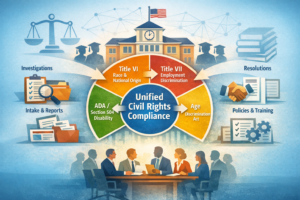 Title IX used to occupy a relatively defined lane for many schools, colleges, and universities. Today, that lane is wider – and still widening. As the civil-rights landscape evolves, many Title IX Coordinators are being asked to oversee compliance responsibilities that extend well beyond sex-based discrimination. Institutions increasingly expect the same office, or the same leadership team, to address Title VI concerns involving race, color, and national origin; Title VII employment discrimination; disability discrimination and accommodations under Section 504 and the ADA; and age-related protections under the Age Discrimination Act. This expanded scope can strengthen equity and reduce risk, but it creates operational strain when each statute is treated as an isolated program.
The Problem With Siloed Compliance
This shift is not just a staffing change. It affects how institutions receive reports, investigate complaints, provide supportive measures, communicate with parties, and track patterns across departments. When schools manage each protected-class framework in separate silos, they often produce inconsistent timelines, mismatched definitions, duplicative documentation, and occasionally conflicting outcomes. Those inconsistencies frustrate not only complainants and respondents but also stakeholders. They increase compliance risk because regulators, courts, and stakeholders focus on whether the institution acted consistently, transparently, and fairly.
Why the Pressure Is Increasing
Many compliance leaders have seen this coming, but the pace is accelerating. Employers in education now operate under a patchwork of federal and state civil-rights laws, each enforced by different agencies with different expectations. Some areas are governed by detailed regulations, while others are shaped by agency guidance, enforcement trends, and case law. When an institution runs these frameworks separately, teams may apply different standards to the same conduct depending on where a report first lands. That approach can create confusion and distrust—especially where complaints involve overlapping or intersectional issues, such as race and gender, disability and national origin, or sex-based harassment in an employment setting.
A Better Approach: A Unified Civil Rights Compliance Ecosystem
Institutions can respond by building a unified civil-rights compliance ecosystem rather than a collection of disconnected processes. “Unified” does not mean collapsing legal requirements into one generic procedure. It means building shared operational foundations—intake, documentation, communication protocols, and coordination norms—so reports are handled consistently while legal distinctions are still honored. The goal is to reduce the chance that an institution’s response depends on who receives the initial email or which office answers the phone.
Three Structural Models That Commonly Work
There are several workable models for building a coordinated approach:
- Centralized civil-rights office. Multiple compliance functions are housed within a single unit under a single leadership structure.
- Hub-and-spoke model. A lead coordinator (often the Title IX Coordinator) manages strategy, policy alignment, and quality control, while deputy coordinators in HR, student affairs, athletics, academic affairs, or disability services manage day-to-day workflows.
- Distributed coordination model. Cross-functional committees or standing teams meet regularly to align practices, identify conflicts, and monitor trends.
No single model is best for every campus. Any of them can work if the institution defines the scope clearly and invests in consistent processes and shared accountability.
Collaboration as Risk Mitigation
Collaboration is what makes these models functional, and institutions should treat collaboration as risk mitigation rather than “territory surrender.” When leaders collaborate, they can:
- Create one intake pathway that routes matters to the right process without requiring the reporting party to understand legal categories.
- Use consistent documentation that captures core facts needed across frameworks.
- Align basic procedural guardrails, such as how supportive measures are documented, how interim steps are communicated, and how timeliness is tracked.
- Reduce the risk of conflicting decisions when a complaint implicates multiple protected classes or spans different respondent populations (e.g., student conduct and employee misconduct).
Common Transition Challenges
Institutions often face predictable friction when they attempt this shift. Legacy systems can pull teams back into siloed habits, especially where departments historically “owned” their forms and processes. Unclear jurisdiction lines can cause delays while offices debate who leads. Uneven resource allocation and competing priorities can create bottlenecks, with one office carrying the investigative load while another controls key information or communications. Institutions also run into trouble when they apply different due-process expectations to students, staff, and faculty without planning for the operational impact.
The solution usually starts with an intentional assessment: identify what the various civil-rights processes share operationally and what must remain distinct.
Step One: Audit Policies and Process Flow
A strong foundation begins with a policy audit that identifies overlap, gaps, and conflicting language across nondiscrimination policies, employee handbooks, student codes, and grievance procedures. When policies define protected classes differently or impose inconsistent reporting standards, the institution invites procedural disputes and uneven outcomes.
A useful audit does not stop at redlines. It maps the workflow from intake through closure, identifies friction points, and assigns ownership at each step to prevent handoff delays.
Step Two: Clarify Roles, Routing, and Authority
Institutions benefit from clear organizational charts and reporting lines so stakeholders understand roles, escalation paths, and decision authority. When a Title IX office receives a report implicating disability accommodations, the institution should not have to improvise who leads, who advises, and who communicates with the parties.
Routing protocols help prevent delays and reduce the risk that one office makes promises another office cannot keep. At a minimum, routing should address: how jurisdiction is determined, how intersectional complaints are handled, and how parallel processes are coordinated when obligations overlap.
Step Three: Standardize the Operational Backbone
Once intake and routing are aligned, institutions can design resolution processes that account for different populations and frameworks without reinventing the wheel each time. Schools can implement multi-path procedures for students, staff, and faculty while maintaining consistent documentation and communication across processes.
A case-closure checklist is also a practical control. It reduces the risk of missed steps by ensuring required notices, supportive measures documentation, recordkeeping, and follow-up actions are completed even during high-volume periods.
Training, Cross-Training, and Program Health
Training and cross-training make the system durable. Institutions should train coordinators, investigators, informal resolution facilitators, decision-makers, and advisors so continuity does not depend on a single person’s institutional memory. Regular coordination among legal counsel, HR, student affairs, academic leadership, compliance and risk teams, student conduct, and faculty affairs also improves consistency and helps leadership spot patterns early.
Continuous Assessment and Pattern Tracking
Compliance does not end when a case closes. Annual self-assessments, climate surveys, equity audits, and post-matter debriefings help institutions identify process drift and systemic vulnerabilities. Reviewing trends in reports, timelines, supportive measures, and outcomes enables institutions to address issues early and demonstrate that the program is designed to learn—not merely to check boxes.
Closing Thought
Civil-rights compliance is ultimately about access, equity, and institutional integrity. When education employers thoughtfully expand beyond Title IX, they can build systems that address discrimination and harassment with clarity, fairness, and consistency, and reduce risk by demonstrating their work through repeatable processes and defensible documentation.
If you’d like to talk through these issues, contact Hoyer Law Group, PLLC to continue the conversation.