

March 25, 2026 | Posted By: Sean Estes
The federal government’s escalating conflict with the artificial intelligence (“AI”) company Anthropic has captured headlines, but its implications reach far beyond the tech industry. If your business holds a government contract, subcontracts under one, or is considering entering the federal marketplace, this dispute carries lessons you cannot afford to ignore.
Here is what happened, what it means, and what steps your business should consider taking.
The Backstory: A Contract Negotiation That Became a National Story
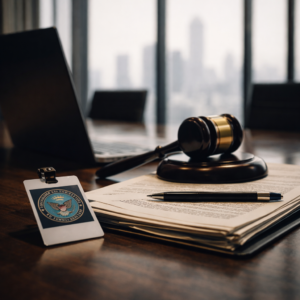 In July 2025, Anthropic signed a $200 million contract with the Department of Defense, making its AI model the first approved for use on classified government networks. As part of the deal, the Pentagon agreed to abide by Anthropic’s acceptable use policy, which included two restrictions: the technology could not be used for mass surveillance of American citizens, and it could not power fully autonomous weapons systems that operate without human oversight of targeting and firing decisions.
When the Pentagon later sought to renegotiate those restrictions, Anthropic’s CEO publicly refused, stating that the company’s position was firm. The administration’s response was swift and severe. On February 27, 2026, President Trump directed all federal agencies to stop using Anthropic’s technology. That same day, Defense Secretary Pete Hegseth announced that the DOD would designate Anthropic as a “supply chain risk to national security,” a label previously reserved for foreign adversaries, such as certain Chinese technology firms.
The formal designation followed in early March. On March 9, 2026, Anthropic filed lawsuits in both California federal court and the D.C. Circuit Court of Appeals, calling the government’s actions “unprecedented and unlawful” and arguing that the designation was retaliatory.
Why This Matters for Businesses Beyond the Tech Sector
You do not need to be an AI company to feel the effects of this dispute. The government invoked two legal mechanisms that apply broadly to the federal contracting ecosystem.
The first is 10 U.S.C. § 3252, which gives the Secretary of Defense authority to exclude a source from DOD procurements involving national security systems to reduce supply chain risk. The second is the Federal Acquisition Supply Chain Security Act (FASCSA), a 2018 law that established a process for banning specific vendors and products from government contracts when deemed to pose a security threat. FASCSA orders are implemented through clauses in the Federal Acquisition Regulation (FAR), particularly FAR 52.204-29 and FAR 52.204-30, which impose monitoring, reporting, and compliance obligations on contractors at every tier.
What makes the Anthropic situation unusual is that these tools were designed to address threats from foreign adversaries, not disputes with American companies over contract terms. Critics of the designation point out that the statute defines a supply chain risk as the danger that “an adversary may sabotage, maliciously introduce unwanted function, or otherwise subvert” a covered system, and argue that a contractual disagreement does not fit that definition.
The government sees it differently. In a court filing on March 18, 2026, the DOJ argued that the designation was a reasonable response to legitimate national security concerns, not retaliation for protected speech. According to the DOJ, an internal Pentagon review concluded that the risk posed by Anthropic had escalated from a manageable business negotiation to an unacceptable national security threat. The government pointed out that AI systems rely on software guardrails that the vendor can modify unilaterally, potentially leading critical defense systems to fail due to unapproved changes. The DOJ also characterized Anthropic’s refusal to accept the Pentagon’s proposed contract terms as “conduct, not free speech,” and argued that the administration is owed “double deference” on matters involving both national security and government procurement.
Regardless of which side ultimately prevails, the dispute illustrates something important for the broader business community: the government has powerful enforcement tools at its disposal, and when a contractor relationship goes sideways, those tools can be deployed quickly and with significant consequences.
Immediate Obligations for Current Government Contractors
If your business holds a government contract that contains the FASCSA clauses (FAR 52.204-29 and FAR 52.204-30), you already have specific obligations in response to the Anthropic designation.
Under these provisions, contractors must check the System for Award Management (SAM.gov) at least once every three months for new FASCSA orders. If a new order could affect your supply chain, you are required to conduct a “reasonable inquiry” to determine whether you have used or provided any products or services from the designated source. If you discover that you have, you must report it to your contracting officer within 3 business days. A mitigation and corrective action plan must be submitted within 10 days. These obligations flow down to subcontractors at every level.
For businesses performing DOD work involving national security systems, the DFARS clause at 252.239-7018 may impose additional requirements under the Section 3252 authority.
The Broader Risk: Government Retaliation Over Contract Disputes
Perhaps the most significant takeaway from this situation has nothing to do with supply chain security. It is the signal it sends about what can happen when a contractor disagrees with the government.
Multiple legal commentators have compared the administration’s treatment of Anthropic to its approach toward law firms, universities, and other organizations that have resisted government demands on unrelated policy matters. The pattern is similar: the government makes a request, the private party declines, and the government responds with punitive measures that carry significant financial and reputational consequences.
The concern is not theoretical. In amicus briefs filed with the D.C. Circuit on March 17, 2026, a broad coalition of organizations and individuals lined up behind Anthropic’s challenge. Major technology trade associations, including TechNet, the Software and Information Industry Association, the Information Technology Industry Council, and the Computer & Communications Industry Association, told the court that the administration’s actions have sent a “ripple of uncertainty” through the tech sector, leaving hundreds if not thousands of companies struggling to interpret shifting government statements. A group of more than a dozen former senior national security officials, including former National Security Advisor Susan Rice and former Director of National Intelligence Avril Haines, argued that the government took a “sentence first, verdict afterward” approach and that the designation was pretextual. And a group of values-led investors warned the court that the current environment makes rational investment decisions nearly impossible, because any American company working with the government now faces the risk of being labeled an adversary at any time and for any reason.
This is not how contract disputes are supposed to work, according to Anthropic and its supporters. Federal law has long recognized that the government cannot retaliate against a contractor for exercising its legal rights. The Eleventh Circuit held in Bank of Jackson County v. Cherry that the First Amendment right to petition the government for redress of grievances includes a right of access to the courts, and that the government “burdens this right when it prosecutes an individual solely because that person refuses to release civil claims.” The Supreme Court affirmed in Board of County Commissioners, Wabaunsee County, Kansas v. Umbehr, 518 U.S. 668 (1996), that contractors may sue for damages based on First Amendment retaliation.
Anthropic’s lawsuit raises these very arguments, claiming the government is punishing the company for its protected speech about the limitations of AI technology and AI safety. The ACLU and the Center for Democracy and Technology have also filed an amicus brief supporting Anthropic’s position, arguing that the company’s public advocacy for AI guardrails is protected by the First Amendment.
The government, for its part, maintains that the designation was a response to Anthropic’s commercial conduct, specifically its refusal to accept the Pentagon’s proposed contract terms, rather than a punishment for the company’s public statements. In a separate amicus brief filed on March 18, nearly 150 former federal and state judges pushed back on the government’s “double deference” argument, telling the D.C. Circuit that national security is not a blanket shield from judicial review. The former judges pointed to landmark Supreme Court decisions, from the steel seizure case during the Korean War to the Pentagon Papers dispute, as evidence that courts have long been willing to check executive overreach even when the government invokes national security. A California federal judge is scheduled to hold a hearing on Anthropic’s request for a preliminary injunction on March 25, 2026. The outcome of this litigation could have lasting implications for every company that contracts with the federal government.
What Your Business Can Do Now
Whether or not you use AI products in your government work, the DOD-Anthropic dispute highlights the importance of proactive risk management for any business in the federal contracting space. Here are steps worth considering.
First, review your existing government contracts and subcontracts to determine whether they include the FASCSA clauses or the DFARS supply chain risk provisions. If they do, make sure your compliance team understands the monitoring and reporting obligations these clauses impose.
Second, take inventory of the technology products and services your business uses in performing government work. Know your supply chain. If a vendor you rely on becomes the subject of a designation, you will need to respond quickly and with accurate information.
Third, document your contract negotiations carefully. If a dispute arises with a government customer, clear records of what was communicated, when, and by whom can be essential in protecting your rights.
Fourth, if you are a business considering entering the government contracting space for the first time, understand that working with the federal government comes with unique legal risks. The regulatory framework is complex, and the consequences of noncompliance can be severe. Getting experienced legal guidance before you sign your first contract is a smart investment.
Protecting Your Business in a Changing Landscape
The DOD-Anthropic dispute is still unfolding, and its full impact on the contracting community will take time to become clear. But the core lesson is already visible: businesses that work with the federal government need to understand their rights, their obligations, and the tools the government can use when a relationship goes sideways.
At Hoyer Law Group, we help businesses navigate complex commercial disputes, government compliance challenges, and contract negotiations. If you are a government contractor evaluating your risk exposure or a business facing a dispute with a federal agency, our attorneys are ready to help.
If you are a government contractor employee who has witnessed fraud, waste, or abuse in federal contracting, you may have protections and potential financial rewards under the False Claims Act. The attorneys at Hoyer Law Group have decades of combined experience representing whistleblowers in some of the most consequential False Claims Act cases in the country.
Contact Hoyer Law Group today for a confidential evaluation of your situation. Visit www.hoyerlawgroup.com/contact/ or call (844) 531-0082.
This blog is for general informational purposes only and does not constitute legal advice. For advice specific to your situation, please consult a qualified attorney.