



March 10, 2026 | Posted By: Sean Estes
 Federal employment lawsuits surged to their highest levels in nearly a decade last year. According to a 2026 Employment Litigation Report by Lex Machina, a legal analytics provider, plaintiffs filed 26,635 employment law cases in federal courts in 2025, the highest total since at least 2016. The increase was fueled primarily by a sharp rise in workplace discrimination and disability accommodation claims, while wage and hour cases under the Fair Labor Standards Act (“FLSA”) continued a prolonged decline.
Whether you are an employee who suspects your workplace rights have been violated or an employer trying to stay ahead of compliance obligations, these trends deserve your attention. Below, we break down the key findings and what they mean for you.
Discrimination Filings Cross 20,000 for the First Time
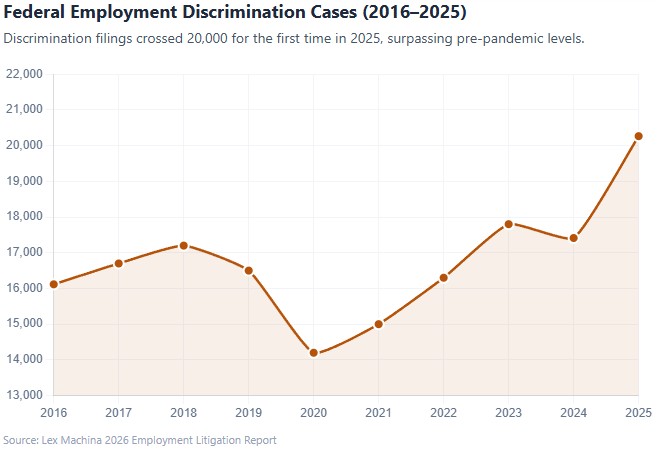 The most striking headline from the report is the surge in workplace discrimination cases. In 2025, new employment discrimination filings in federal court crossed 20,000 for the first time, reaching 20,265. That figure was significantly higher than 17,413 in 2024 and 16,116 in 2016.
Several recent U.S. Supreme Court decisions have expanded employees’ ability to bring discrimination claims, and legal experts believe these rulings are driving the increase.
Muldrow v. City of St. Louis (2024): Lowering the Bar for Harm
In April 2024, the Supreme Court unanimously held in Muldrow v. City of St. Louis that an employee bringing a Title VII discrimination claim need not prove “significant” harm. Instead, the employee only needs to show “some harm” to an identifiable term or condition of employment.
The case involved a female police sergeant who was involuntarily transferred from a prestigious plainclothes investigative role to a routine patrol assignment. Her pay and rank stayed the same, but she lost access to high-profile cases, a take-home vehicle, and a steady weekday schedule. Lower courts had dismissed her claim because the changes were not “materially significant.” The Supreme Court reversed, finding that Title VII’s text contains no heightened harm requirement.
For employees, this means workplace discrimination need not involve a firing, demotion, or pay cut to be actionable. Unwanted transfers, reduced responsibilities, schedule changes, and loss of workplace privileges may all support a claim if they were motivated by a protected characteristic such as race, sex, age, or disability.
For employers, the takeaway is clear: any change to an employee’s job duties, schedule, or working conditions that is motivated by a protected characteristic could create liability, even if the employee’s pay and title remain unchanged. Documenting legitimate, nondiscriminatory reasons for employment decisions has never been more important.
Ames v. Ohio Department of Youth Services (2025): Equal Standards for All Plaintiffs
In June 2025, the Supreme Court issued another unanimous ruling in Ames v. Ohio Department of Youth Services, further broadening the scope of Title VII claims. The Court held that employees who belong to a majority group, such as those who are white, male, or heterosexual, do not face a higher evidentiary bar when bringing discrimination claims.
Previously, some federal courts required so-called “reverse discrimination” plaintiffs to show special “background circumstances,” suggesting their employer was the rare kind of organization that would discriminate against majority-group workers. In Ames, the Court rejected this additional requirement, holding that Title VII protects “any individual” from discrimination and does not distinguish between majority-group and minority-group employees.
This decision is expected to increase discrimination filings from all corners of the workforce, including claims challenging diversity, equity, and inclusion (DEI) programs when those programs result in adverse treatment of employees based on a protected characteristic.
Bostock v. Clayton County (2020): Continuing Impact
Though decided five years ago, the Supreme Court’s landmark ruling in Bostock v. Clayton County continues to generate new litigation. In Bostock, the Court held that Title VII’s ban on sex discrimination includes discrimination based on sexual orientation and gender identity. As more employees become aware of this protection, filings involving LGBTQ+ workplace discrimination have continued to grow.
Disability Accommodation Claims Skyrocket
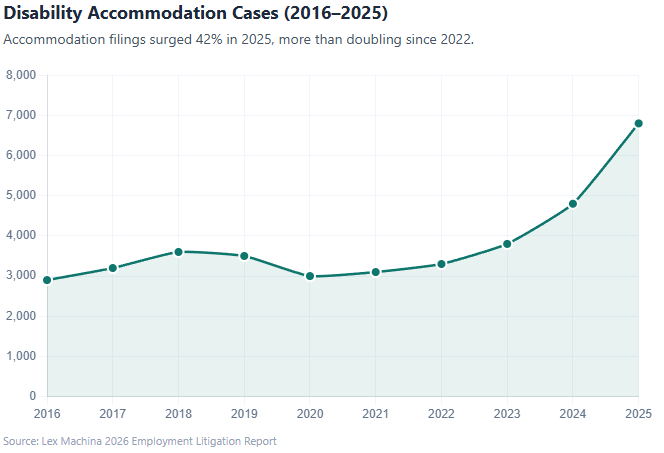 Disability accommodation cases saw the sharpest year-over-year increase of any claim type in the report. Filings rose approximately 42% in 2025 from the prior year, reaching roughly 6,800 cases. That number has more than doubled since 2022.
Several factors appear to be driving this trend. The ongoing effects of long COVID have left many workers with chronic health conditions that require workplace accommodations. At the same time, large damage awards in recent disability cases may be encouraging new plaintiffs to come forward.
Perhaps most significantly, the widespread rollback of remote work policies has created friction between employers and employees with disabilities. When companies implemented sweeping return-to-office mandates with few exceptions, employees who needed to work from home as a reasonable accommodation under the Americans with Disabilities Act (“ADA”) found themselves in conflict with their employers.
Under the ADA, employers are required to engage in an interactive process with employees who request accommodations for a disability, and to provide reasonable accommodations unless doing so would cause an undue hardship on the business. A blanket return-to-office policy that makes no room for individualized accommodation requests can put an employer at legal risk.
FMLA Cases Surge to a Nine-Year High
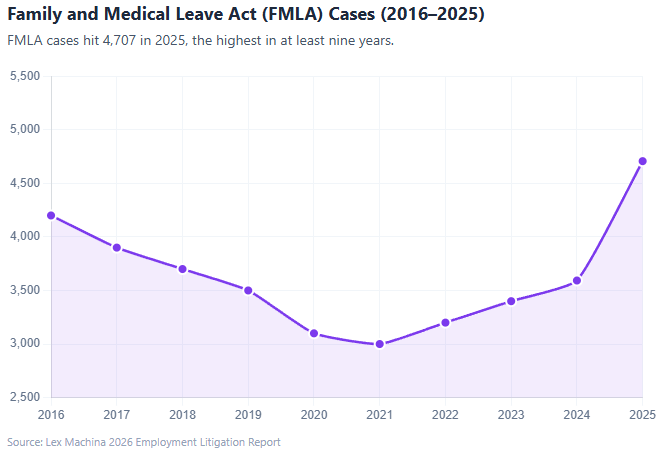 Family and Medical Leave Act (“FMLA”) filings also climbed sharply, from 3,593 in 2024 to 4,707 in 2025, the highest number since at least 2016. The report attributed this increase to workforce shortages, greater awareness of employee rights, and rising caregiving needs among workers.
The FMLA provides eligible employees with up to 12 weeks of unpaid, job-protected leave per year for qualifying reasons, including a serious health condition, the care of a family member with a serious health condition, or the birth or adoption of a child. Employers who interfere with an employee’s right to take FMLA leave, or who retaliate against an employee for exercising that right, can face significant legal liability.
If you have been denied FMLA leave, disciplined for taking leave, or terminated shortly after returning from leave, you may have a claim against your employer.
FLSA Wage and Hour Cases Continue to Decline
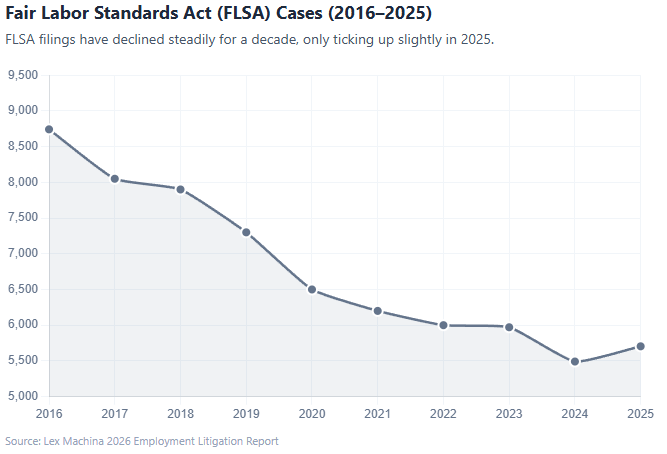 Not all categories of employment litigation are on the rise. Fair Labor Standards Act (“FLSA”) cases have been declining for the better part of a decade. In 2025, plaintiffs filed 5,704 new FLSA cases in federal courts, a slight uptick from 5,491 in 2024 but well below the 8,742 filed in 2016.
Several factors are contributing to this trend. Employers have improved their wage-and-hour compliance. Mandatory arbitration agreements are diverting more disputes out of the court system. And in many states, particularly on the West Coast, plaintiffs and their attorneys are choosing to bring wage claims under state laws that offer stronger protections, higher penalties, and more favorable procedural rules than the FLSA.
Collective action filings under the FLSA have also declined, with 2,474 putative collective actions filed in 2025, compared with 3,957 in 2016. Meanwhile, class action filings under state laws have been increasing, with more than 1,100 filed in 2025, the highest total since at least 2009.
The EEOC Landscape Is Shifting
It is also worth noting that the U.S. Equal Employment Opportunity Commission (“EEOC”) is undergoing significant changes. According to its most recent annual performance report, the EEOC received 88,531 new charges of discrimination in fiscal year 2024, a 9.2% increase over the prior year. However, the agency’s own litigation activity has declined, with the EEOC filing only 93 merit lawsuits in fiscal year 2025, a ten-year low, due in part to leadership changes and shifting enforcement priorities under the current administration.
When the EEOC becomes less active in pursuing cases directly, it often issues more right-to-sue notices, which push more cases into federal court through private litigation. This may be one additional factor behind the rise in discrimination filings.
For employees, this means it is more important than ever to consult with an experienced employment attorney rather than relying solely on the EEOC process. For employers, the reduced agency presence does not reduce legal exposure, as private plaintiffs are filling the gap.
What This Means for You
If you are an employee: The law is evolving in ways that strengthen protections against workplace discrimination, disability-related mistreatment, and interference with FMLA. If you have experienced unfair treatment at work, whether it involves a termination, a demotion, an unwanted transfer, a denied accommodation, or retaliation for exercising your rights, you may have a viable legal claim. Do not assume that your situation is “not bad enough” to warrant legal action. Recent Supreme Court rulings have made clear that even relatively modest harms can support a discrimination claim.
If you are an employer: With discrimination and accommodation filings at all-time highs, proactive compliance is essential. Ensure your managers are trained on anti-discrimination policies, document the legitimate business reasons behind all employment decisions, engage in the interactive process when employees request accommodations, and review your return-to-office policies for ADA compliance. Consult with employment counsel before implementing broad policy changes that could disproportionately affect employees with disabilities or other protected characteristics.
Contact Hoyer Law Group
Whether you are an employee whose workplace rights have been violated or a business looking to strengthen your compliance practices, Hoyer Law Group is here to help. Our employment attorneys represent both employees and employers in discrimination, harassment, retaliation, FMLA, and accommodation matters in state and federal courts nationwide.
Contact us today for a confidential evaluation at www.hoyerlawgroup.com/contact/ or call (844) 531-0082.
This blog is for general informational purposes only and does not constitute legal advice. For advice specific to your situation, please consult a qualified attorney.